Latvian start-up Oruga creates a unique single-track caterpillar vehicle
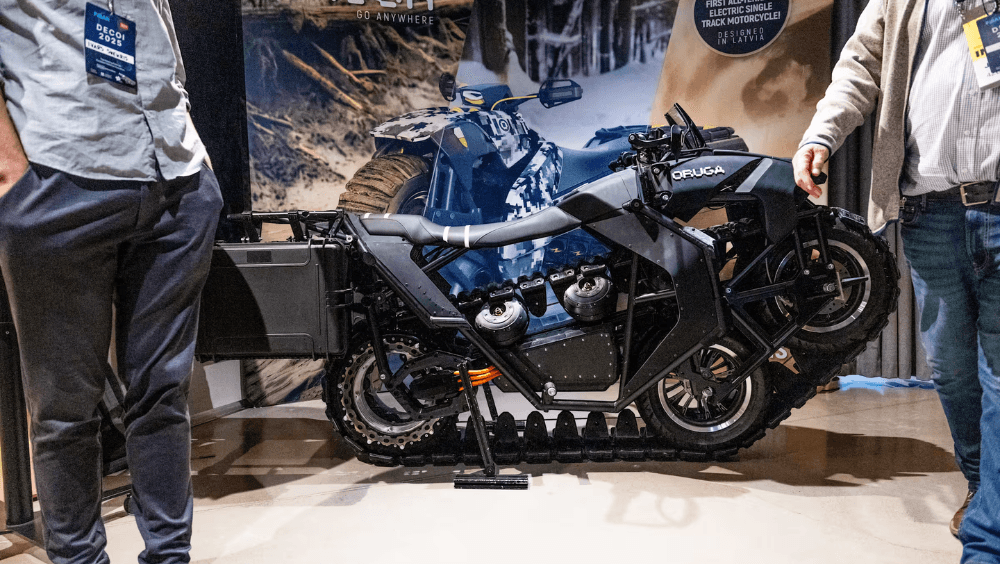
The science-intensive Latvian start-up Oruga is working on a unique vehicle – the Unitrack single-track caterpillar motorcycle. This innovative vehicle combines the agility of a motorcycle with the power of a tank, allowing it to travel on sand, mud, rocks, or snow in any season. In potentially difficult situations, the Unitrack can also dig itself out, making it particularly suitable for challenging off-road conditions. In addition, the design is such that nothing other than the caterpillar track itself comes into contact with the surface, thus solving the problem of the undercarriage getting stuck on obstacles. However, the real innovation lies in the manoeuvrability of the single-track caterpillar – a solution that is unprecedented in the world and whose application in the future could extend far beyond the boundaries of motorcycles and all-terrain vehicles. The company is currently actively seeking a strategic investor to take the next step – the establishment of its first production facility.
The company was founded in 2023 in Latvia. The co-founders of Oruga, Liene Vītola (CEO), Juris Kļava (CTO), Kaspars Barons (CFO), and Erick Pastor (Marketing Consultant) have been joined by advisers with international experience in vehicle manufacturing, off-road racing, and military technology, who are helping to develop the idea into a world-class innovation. By combining this unique knowledge from different industries, the company’s first Unitrack prototype was developed in-house in just eight months. The company is now working on the next-generation model, which will soon be ready for production.
“Until now, caterpillar tracks have always moved only forward or backward. In order for the vehicle to manoeuvre, one track was moved forward while the other was moved backward, thus achieving a turn. We were the first in the world to create a rotatable and manoeuvrable single electric caterpillar track. This essentially changes the rules of the game for the entire off-road transport industry,” Liene Vītola, co-founder of Oruga, says about the innovative technology.
Previous off-road vehicles, even the most powerful ones, often lost the battle with nature as their two-track and wheel systems made them vulnerable to getting stuck. “All off-road vehicles to date have been built on two sets of tracks or wheels, and in between them there is always a so-called “belly” – a fixed lower part that not only tends to get stuck on rocks and protrusions when off-roading, but is also the main cause of getting stuck on soft or loose terrain. We solved this problem, and our single-track design can even crawl out of mud or snow thanks to the angle of the caterpillar track at the front,” she explains.
A dual-purpose product with broad potential
The company’s Unitrack motorcycle and its single-track caterpillar technology are a dual-purpose solution with broad market potential, both in the high-end off-road entertainment segment and for professional and military use. Oruga Unitrack could become an important tool for border guards, rescue services, and the defence industry. It is also potentially suitable for construction and infrastructure service companies, for example, to inspect critical infrastructure objects, construction sites, or mineral extraction sites over a wide area.
“This is a vehicle that can be used all year round on any terrain, in any weather conditions and anywhere in the world. While a quad bike cannot be used in the snow or a snowmobile on sand, the Oruga Unitrack can do both and more,” Liene Vītola says.
State support as a springboard for development
Oruga is a member of the Investment and Development Agency of Latvia’s (LIAA) incubator in the Technology Business Centre in Riga and actively uses the support instruments offered by the state – from co-financing for innovation development to participation in trade missions and international exhibitions. This fall, the company’s team travelled to Washington, D.C., as part of a trade mission to the United States organised jointly by LIAA and the Ministry of Economics of Latvia from October 13 to 17. There, the entrepreneurs visited one of the largest defence industry exhibitions, the AUSA Annual Meeting & Exposition, and participated in the Latvian-American Chamber of Commerce (LACC) conference Spotlight Latvia.
“It was like opening the door to a whole new world. In one week, we met more people and gained more valuable contacts than we could ever have done on our own. We had the opportunity to talk to industry leaders, potential investors and manufacturers, and each meeting was meaningful. I can safely say that this experience shortened our path to success by at least a year,” says Liene Vītola.
“We have now created the technology and proven that it works. The next step is to build muscle and go global. North America is a huge market and, in terms of regulations, much more unified than Europe, so that is our number one goal. However, our roots are in Latvia; Europe is definitely one of our target markets and will remain so, but we will probably focus on it after entering the North American market. Each country has different regulations for innovative mobility technologies, and this affects the speed of their implementation. The decision on the location of the production facility will also be closely linked to the vision of the investor we choose,” says Liene Vītola, when talking about the company’s next steps.
Information material prepared with the support of the European Regional Development Fund
